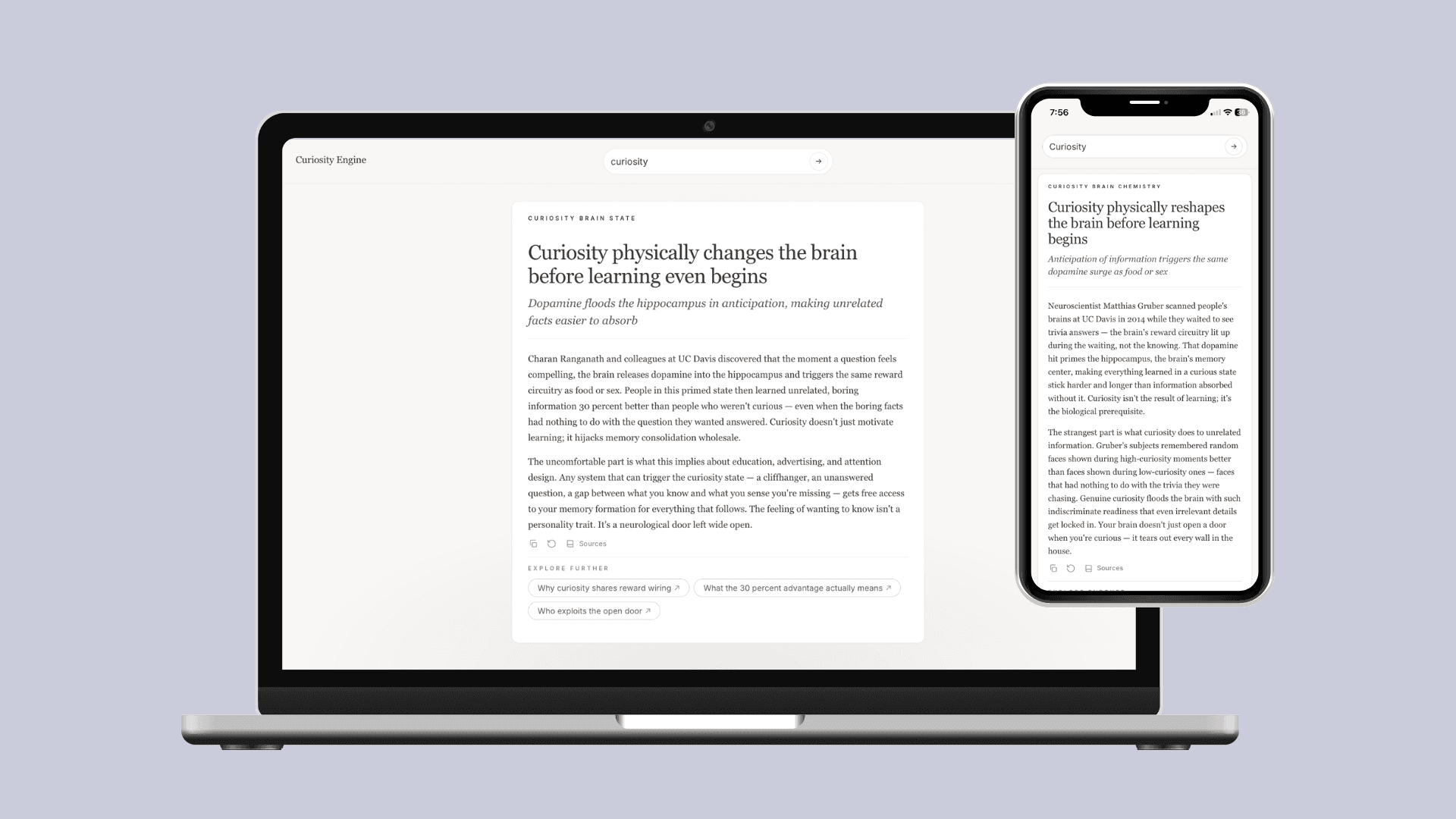
Designing a generative experience that lets curiosity happen naturally.

A generative experience for the intellectually restless.

ROLE

Solo designer + developer

METHODS

Competitive analysis, prompt engineering, prototyping

FOCUS

Interaction design, UX for generative interfaces

CONTEXT

2026 · Personal concept

ROLE

Solo designer + developer

METHODS

Competitive analysis, prompt engineering, prototyping

FOCUS

Interaction design, UX for generative interfaces

CONTEXT

2026 · Personal concept

OVERVIEW

Curiosity Engine turns AI from an answer engine into a starting point for discovery, helping people follow ideas, make connections, and see where their curiosity takes them. Designed to make exploration feel more natural than prompting.

CHALLENGE

Curiosity can start with a feeling, a connection, or a passing thought, rather than a fully formed question.

I wanted to explore whether AI could move curiosity forward while still leaving the user in control of where it goes.

COMPETITIVE LANDSCAPE

What existing AI interfaces get right, and what they require from the user.

Existing AI tools are increasingly good at helping people follow a question. I wanted to explore what happens when the system helps create the question in the first place.

Perplexity

Makes research easier by grounding answers in sources, but users still need to know what they want to investigate.

NotebookLM

Makes it easier to explore a body of information conversationally, but users need to bring the source material themselves.

Claude / ChatGPT

Powerful when users already have a question, but they require users to initiate and direct the interaction.

Curiosity Engine

Explores what happens when the system provides the initial momentum instead of waiting for the user to provide a prompt.

Perplexity

Makes research easier by grounding answers in sources, but users still need to know what they want to investigate.

NotebookLM

Makes it easier to explore a body of information conversationally, but users need to bring the source material themselves.

Claude / ChatGPT

Powerful when users already have a question, but they require users to initiate and direct the interaction.

Curiosity Engine

Explores what happens when the system provides the initial momentum instead of waiting for the user to provide a prompt.

THE PRINCIPLE

The system should generate momentum, not dictate direction.

01

Generate momentum without taking over.

The system should be proactive enough to keep exploration moving, but not so directive that it determines where the user should go. I designed the generated content to suggest possible directions while leaving the decision of what to follow entirely to the user.

02

Let the system show its assumptions.

AI systems often make assumptions about what a user means and move forward as if those assumptions are correct. Instead of hiding that uncertainty, I made the system surface its interpretation and ask, “Is this what you meant?” before continuing.

03

Keep curiosity alive instead of closing it.

When a response gives users a definitive answer, the interaction naturally comes to an end. I redesigned the prompts to surface related questions, tensions, and possibilities so that each response could lead somewhere new.

THE PRINCIPLE

The system should generate momentum, not dictate direction.

01

Generate momentum without taking over.

The system should be proactive enough to keep exploration moving, but not so directive that it determines where the user should go. I designed the generated content to suggest possible directions while leaving the decision of what to follow entirely to the user.

02

Let the system show its assumptions.

AI systems often make assumptions about what a user means and move forward as if those assumptions are correct. Instead of hiding that uncertainty, I made the system surface its interpretation and ask, “Is this what you meant?” before continuing.

03

Keep curiosity alive instead of closing it.

When a response gives users a definitive answer, the interaction naturally comes to an end. I redesigned the prompts to surface related questions, tensions, and possibilities so that each response could lead somewhere new.

THE PRINCIPLE

The system should generate momentum, not dictate direction.

01

Generate momentum without taking over.

The system should be proactive enough to keep exploration moving, but not so directive that it determines where the user should go. I designed the generated content to suggest possible directions while leaving the decision of what to follow entirely to the user.

02

Let the system show its assumptions.

AI systems often make assumptions about what a user means and move forward as if those assumptions are correct. Instead of hiding that uncertainty, I made the system surface its interpretation and ask, “Is this what you meant?” before continuing.

03

Keep curiosity alive instead of closing it.

When a response gives users a definitive answer, the interaction naturally comes to an end. I redesigned the prompts to surface related questions, tensions, and possibilities so that each response could lead somewhere new.

PROMPT ARCHITECTURE

Designing the curiosity loop

Every element is designed to open something, not close it. The headline draws the reader in, the body gives a range of things to pull on, and the chips point somewhere you haven’t been yet.

1

2

3

4

5

6

INTERACTION DESIGN

Interactions for a generative interface - beyond chat

When content is generated, interaction has to dissolve into behavior people already have. The reader curates by paying attention, not by navigating.

Highlight to generate

Instead of opening a prompt or tool, reading itself becomes the interaction.

Refresh button

Instead of restarting the conversation, the system offers another angle while preserving the context.

Shuffle topics

Instead of asking the user to invent a prompt, the system gives them something to notice.

REFLECTION

I came into the project assuming that user control meant giving people more ways to direct the system. I left thinking about control differently: users can retain agency through what they choose to follow, ignore, and explore.

The system can generate the momentum, while the user decides what is worth following.

I came into the project assuming that user control meant giving people more ways to direct the system. I left thinking about control differently: users can retain agency through what they choose to follow, ignore, and explore.

The system can generate the momentum, while the user decides what is worth following.